
Knowledge base · Mops and cleaning textiles
Why use an automated mop washing system?
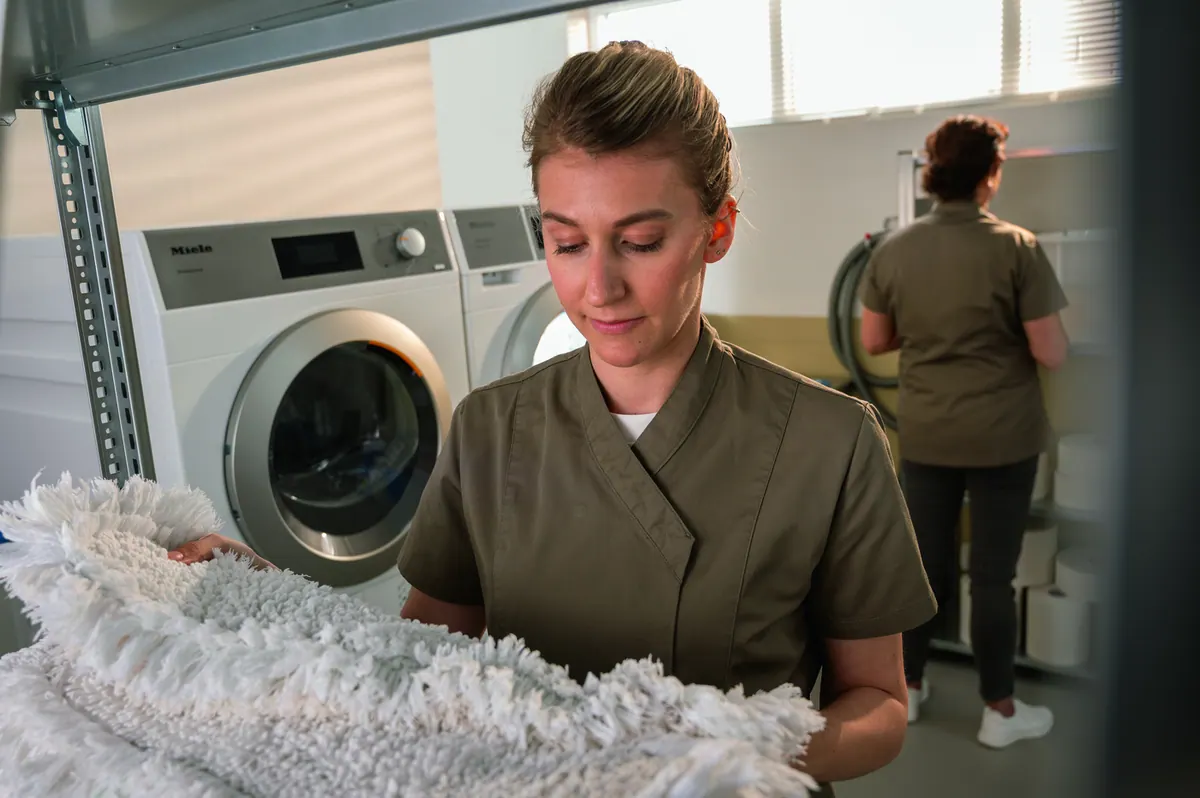
When we think about the efficiency of cleaning processes, chemicals, detergents or the work of cleaning staff often come to mind first. But there is one less visible yet critical element: the mop itself, the tool that removes dirt from surfaces. If this tool is not properly cleaned and reused, cleaning can easily lose its effectiveness – and may even have the opposite effect.
Automated mop washing systems address exactly this hidden risk: in a uniform, controlled and repeatable way, they ensure that the cleaning tool returns to use in a proper hygienic condition every time.
The mop head as a potential source of contamination
During use, a mop continuously collects dust, organic soiling and microorganisms. This in itself is a natural part of the cleaning process. The problem starts when the tool is cleaned poorly or inconsistently.
A damp environment is particularly favourable for the survival of microorganisms. If a mop is not properly washed and dried, the remaining moisture and dirt create an ideal breeding ground for bacteria. Several studies have shown that improperly treated mops can carry a significant microbial load and recontaminate surfaces the next time they are used. This can effectively create a "recontamination cycle" in which cleaning does not reduce contamination but sustains it.
That is why mop cleaning in commercial environments is especially important, where hygiene requirements are higher and the quality of cleaning can directly affect operational safety.
The problem with manual washing: the process is not uniform
One of the biggest challenges of manual mop washing is variability. The same tool can reach different levels of cleanliness after different cleaning cycles.
The most critical factors:
- water temperature (not constant and often not checked),
- inaccurate chemical dosing,
- shortened washing times due to lack of time,
- differing practices and routines among staff.
Because of these, the process is not reproducible, so cleaning quality cannot be guaranteed in every cycle.
A comparative study showed that mechanised washing significantly reduces the microbial load of mop heads compared with manual cleaning, and regular use delivers more stable results.
With a commercial mop washing system, washing parameters can be controlled and standardised, so every wash cycle delivers the same quality. Miele's professional solutions – such as MopStar washing machines – support verifiable and documentable cleaning of cleaning textiles.
The advantage of automation: stable, repeatable quality
One of the most important advantages of automated mop washing systems is process control. These systems do not rely on individual practice or the circumstances of the moment, but work with pre-set, validated programmes.
This means every wash cycle follows the same critical parameters: the water temperature is constant, chemical dosing is precise and the washing time is the same every time. As a result, cleaning quality becomes predictable and the risk from human error is significantly reduced.
This type of professional mop washing is especially important in healthcare facilities, social care settings, hotels, food processing plants and any environment where hygiene plays a key role.
Reducing the risk of cross-contamination
One of the biggest problems with cleaning tools is the potential for cross-contamination. If a mop is not properly cleaned, dirt can be carried from one area to another.
Mechanised systems address this on several levels:
- closed washing processes,
- higher cleaning efficiency,
- separate "soiled" and "clean" phases,
- less manual contact.
In modern hygiene systems, the goal is not to move dirt around but to remove it completely. Proper hygienic mop handling is therefore an essential part of professional cleaning.
Sustainability and long-term costs
Systems suited to modern commercial laundry technology are advantageous not only for hygiene but also economically. Precise chemical dosing and optimised water use reduce waste, while the controlled washing process is gentle on textiles, so they last longer.
In the long run, this means fewer textiles discarded, lower purchasing costs and a more stable level of operating costs. The system therefore supports not only more efficient but also more sustainable operation.
Quality assurance and transparency
In today's operating environments, there is a growing expectation that processes can be documented. Automated systems can record the parameters of wash cycles, making it possible to trace when and with which settings cleaning took place.
This is a significant advantage both in internal quality assurance systems and during external audits, as hygiene processes are not just assumed but can be proven.
Washing mop heads is not a secondary technical step but one of the most important elements of the entire cleaning chain. If this process is not controlled, the reliability of the whole system can suffer.
The essence of automated mop washing systems is that they make the cleaning process predictable, repeatable and documentable. This not only raises the level of hygiene but also improves operational efficiency and sustainability.
Would you like a more stable and predictable cleaning process?
Mielemed's professional laundry technology solutions help ensure that cleaning textiles are cleaned not with variable results, but with the same verifiable quality every time.
Discover our solutions for automated mop washing systems and professional cleaning of cleaning textiles: professional washing of mops and cleaning textiles.